

This is how you check whether your security seals supplier is CTPAT compliant
CTPAT dictates that a high security seal must be affixed to all loaded containers bound for the United States. All seals must meet or exceed the ISO 17712:2013 standard for high security seals. In this article CTPAT and its benefits will be explained shortly. Then ISO 17712:2013 standard’s implications for CTPAT compliant security seal suppliers will be discussed. Finally, this post describes how you can check whether your security seal supplier is CTPAT compliant.
CTPAT meaning
What is CTPAT? CTPAT, which stands for Customs Trade Partnership Against Terrorism, is an AEO program, started by U.S. Customs and Border Protection to strengthen international supply chains and improve United States border security. From its initiation in 2011, CTPAT now has more than 11,400 certified partners. Participating in this program is voluntary. When joining a partner agrees to protect the supply chain, to identify security gaps, and to implement specific security measures and best practices. These evolve over time as technology and knowledge are improving faster and faster. You can access the most current CTPAT minimum security criteria on the official U.S. Customs and Border Protection website.
CTPAT benefits for carriers
Being a certified partner has several advantages. For CTPAT certified carriers some important benefits include:
- Reduced number of CBP examinations
- Front of the line inspections
- Shorter wait times at the border
- Assignment of a Supply Chain Security Specialist to the company
- Importer eligibility to participate in the Importer Self-Assessment Program (ISA)

Being a CTPAT partner offers various advantages for carriers
If you are CTPAT compliant you are also compliant to various foreign partnership programs, such as European Union’s Authorized Economic Operator Program, Mexico’s NEED Program and Canada’s Border Services Agency’s Partners in Protection Program. If you are an exporter to any of these areas or other areas that provide mutual recognition to CTPAT, being a CTPAT partner smooths international trade.
CTPAT seal requirements. What does this mean for your supplier?
CTPAT requires the use of ISO 17712:2013 certified high security seals for sealing cargo bound for the U.S. This standard requires independent confirmation in 3 areas:
- Testing the physical strength of a security seal. ISO 17712 defines 3 types of security seals. Of these 3 only high (“H”) security seals are CTPAT compliant. Security seal suppliers must use independent and accredited third-party laboratories to validate a seal’s classification. These labs must be accredited according to ISO/IEC 17025 to perform testing specific to ISO 17712.
- Auditing of manufacturers’ security related business processes. ISO 17712 defines over 2 dozen required practices, such as facility risk assessments and access controls to production and storage areas. Suppliers’ compliance should be demonstrated through an independent and accredited certification as well.
- Security seals must be designed and constructed with tamper indicative features that generate tell-tale evidence of tampering.

Hoefon Security Seals offers various CTPAT compliant high security seals
How can you check if your security seal supplier is CTPAT compliant?
If you are a CTPAT certified carrier and if you are carrying containers into the United States, a high security seal which meets or exceeds ISO 17712:2013 standards must be affixed to all loaded containers bound for the U.S. To be compliant you should ask your security supplier for copies of conformance certificates for product testing and security related business practices (Normative Annex A of ISO 17712:2013). Moreover, the certificates for product testing should come from a lab that is properly accredited according to ISO procedures, such as 17025. The test house itself must be accredited by an independent third-party test laboratory.
Using CTPAT compliant seals is just one part of being a compliant carrier, but a part that should not be neglected. We hope that this article helps in understanding which criteria your CTPAT compliant security seals suppliers must meet and how you can check this.
Our CTPAT high security seals
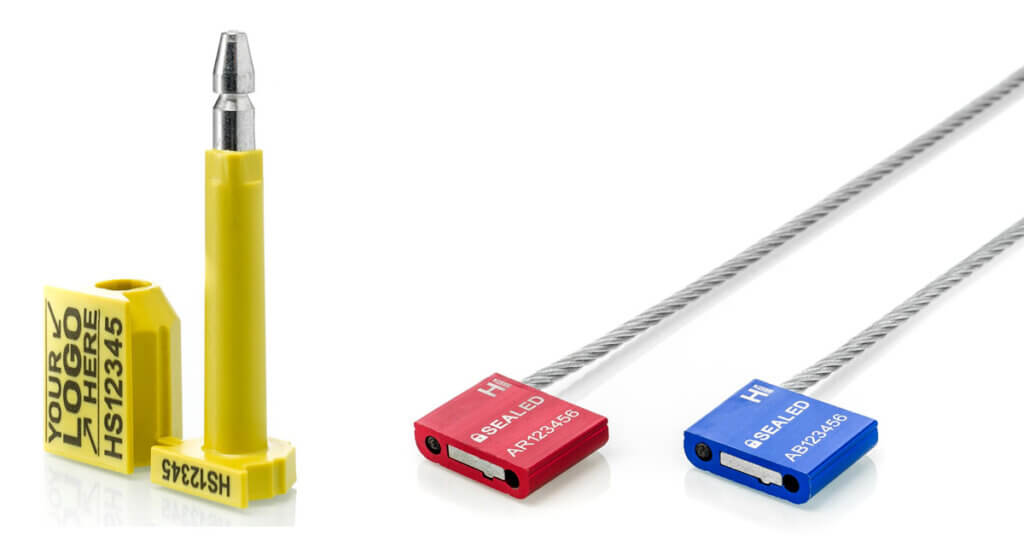
Hoefon Security Seals is a long time CTPAT member and supplies various compliant high security bolt seals and CTPAT cable seals. We offer competitive prices and worldwide, door-to-door shipping. Please feel free to contact us for a free inquiry.
Follow VVTT for applying and checking security seals
Using a CTPAT compliant seal is only effective if the security seal is applied and checked correctly. To support this, U.S. Customs and Border Protection (CBP) has defined recommended seal procedures, commonly known as the VVTT method.
Everyone in the logistics chain (such as loaders, truck drivers, and receivers) should follow these four fixed steps when inspecting a seal:
- V – View: Visually inspect the seal and the container’s locking mechanism. Look for scratches, melt marks, glue residue, or other signs of tampering.
- V – Verify: Check that the unique seal number matches exactly with the number on the relevant shipping documents (such as the Bill of Lading). A single digit difference may indicate an unauthorized replacement.
- T – Twist: Twist the seal and check for unwanted rotation or play, especially with bolt seals, and for any signs of manipulation.
- T – Tug: Pull firmly on the seal to confirm the locking mechanism has clicked into place and will not come loose.
Within the CTPAT program, the VVTT method must be embedded in your seal security procedures for cargo moving into the U.S. and for shipments handled within U.S. export flows.
Any logistics company operating under the CTPAT framework should meet the following requirements:
- Train staff: Employees must be trained to perform the four VVTT inspection steps (View, Verify, Twist, Tug) when using high security seals.
- Keep a logbook: Every physical inspection and the issuance of seals must be recorded consistently and accurately.
If a company cannot demonstrate these procedures during an official audit, it risks its CTPAT status and may lose key operational advantages, such as priority at border inspections and faster cargo release. More information is available via the CBP website.

Niels Pas
CEO Hoefon Security Seals
Niels Pas has been Hoefon Security Seals’ CEO since 2017. He has extensive international experience and speaks 4 languages professionally.